Agrico’s November variety presentations put two processing destinations alongside each other: Sidney for French fries and Napoleon for crisps. Their breeder profiles show why buyers need to look beyond a general promise of yield and match a variety to the product, storage programme and crop-protection requirements.
Two markets, different specifications
Agricoالصورة 2026 show announcement named both varieties for the event held in Bant on 4–6 November. A subsequent trade report also identified their distinct processing roles. The varieties already appear in Agrico’s published portfolio; the presentation should not be confused with proof that both were first released this month.
For a processor, the useful question is which characteristics fit a defined production line. Long fries, sliced crisps and other products do not impose identical requirements on tuber shape or preparation. A variety name becomes commercially meaningful when those requirements are written into a raw-material specification.
أيام الأسبوع. إلغاء الاشتراك بنقرة واحدة.
Sidney’s French-fry positioning
The breeder’s Sidney profile describes an early-maincrop, white-fleshed variety aimed at the French-fry industry, including quick-service restaurants. The table lists long-oval tubers and indicative dry matter of 21.5%. It also records distinct ratings for different diseases: the foliage is described as very susceptible to late blight, while the tuber assessment is more favourable.
That contrast is important. A reference to good virus resistance does not mean resistance to every disease, and a tuber rating does not replace a foliage-management plan. Crop advice must address the actual pathogen, production environment and label requirements for any intended treatment.
Napoleon’s crisping proposition
Agricoالصورة Napoleon profile describes a maincrop crisping variety with uniform tuber size, round-oval shape and indicative dry matter of 24.1%. The company emphasises crisping quality, dry-matter distribution and storage performance. These are breeder descriptions, not acceptance results for a particular delivered lot.
Harvest handling remains relevant alongside those strengths. The same profile identifies sensitivity to harvest damage. A processor or grower comparing varieties should therefore examine the complete description, rather than select only the most favourable catalogue lines. Field conditions, handling and the intended storage interval belong in the assessment.
From catalogue to a supply programme
A useful commercial comparison would keep the intended product, local growing conditions and delivery period constant. Representative lots could then be checked for the buyer’s required size distribution, composition, frying result and usable output. Storage performance should be evaluated at the delivery date, not inferred solely from appearance at harvest.
The November presentations provide a timely opportunity for that discussion. They do not establish a universal winner between two varieties designed for different destinations. For growers, the decision connects seed availability and field management with a real customer. For processors, it connects the variety description with measured performance on the line and a specification that both sides can verify.
النقاط الرئيسية
- Sidney is positioned for French fries; Napoleon is positioned for crisps.
- Read disease ratings separately for foliage, tubers and individual pathogens.
- Validate catalogue characteristics against the buyer’s actual specification and delivery period.
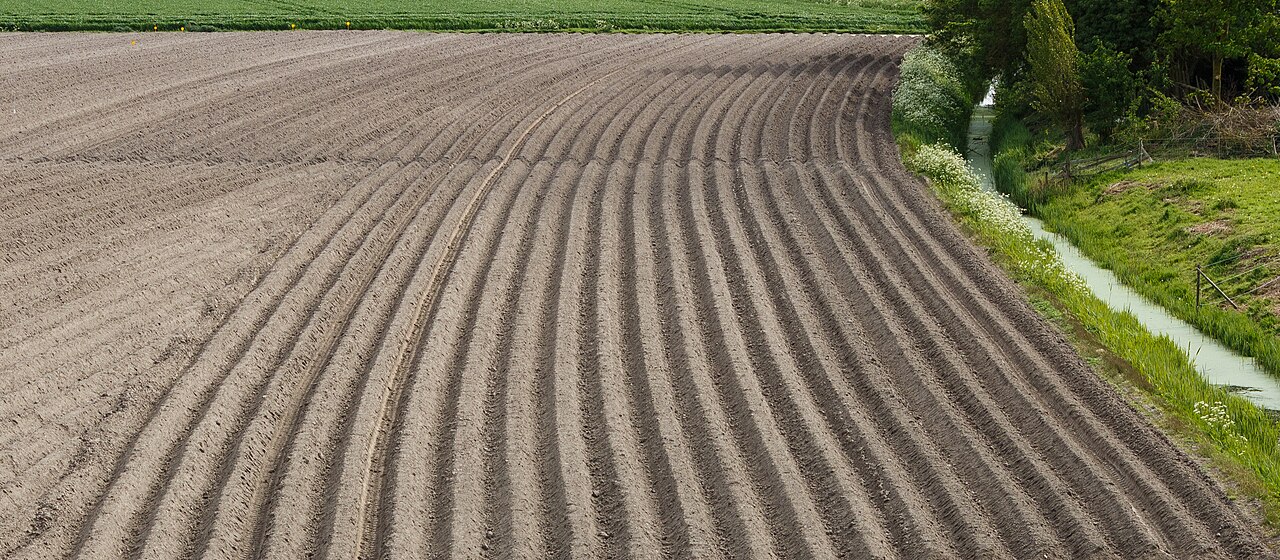
Illustrative potato field in the Netherlands. Photo: Dominicus Johannes Bergsma / Wikimedia Commons, CC BY-SA 4.0.